
- mixin, 已被 React 弃用
- 高阶组件 HOC
- Render Props
HOC
类似工厂模式 装饰器之类的
react
//高阶组件不是一种功能,而是一种模式
const HOCFactory = (Component) => {
  class HOC extends React.Component {
    // 在此定义多个组件的公共逻辑
    render(){
      return <Component {...this.props}/>//返回拼装的结果
    }
  return HOC
}
const EnhancedComponent1 = HOCFactory(wrappedComponent1)示例:
react
import React from 'react'

// 高阶组件
const withMouse = (Component) => {
    class withMouseComponent extends React.Component {
        constructor(props) {
            super(props)
            this.state = { x: 0, y: 0 }
        }

        handleMouseMove = (event) => {
            this.setState({
                x: event.clientX,
                y: event.clientY
            })
        }

        render() {
            return (
                <div style={{ height: '500px' }} onMouseMove={this.handleMouseMove}>
                    {/* 1. 透传所有 props 2. 增加 mouse 属性 */}
                    <Component {...this.props} mouse={this.state}/>
                </div>
            )
        }
    }
    return withMouseComponent
}

const App = (props) => {
    const a = props.a
    const { x, y } = props.mouse // 接收 mouse 属性
    return (
        <div style={{ height: '500px' }}>
            <h1>The mouse position is ({x}, {y})</h1>
            <p>{a}</p>
        </div>
    )
}

export default withMouse(App) // 返回高阶函数redux connect 高阶组件
react
import { connect } from 'react-redux'
// connect 是高阶组件
const VisibleTodoList = connect(
  mapStateToProps,
  mapDispatchToProps
)(TodoList)

export default VisibleTodoListconnect 源码
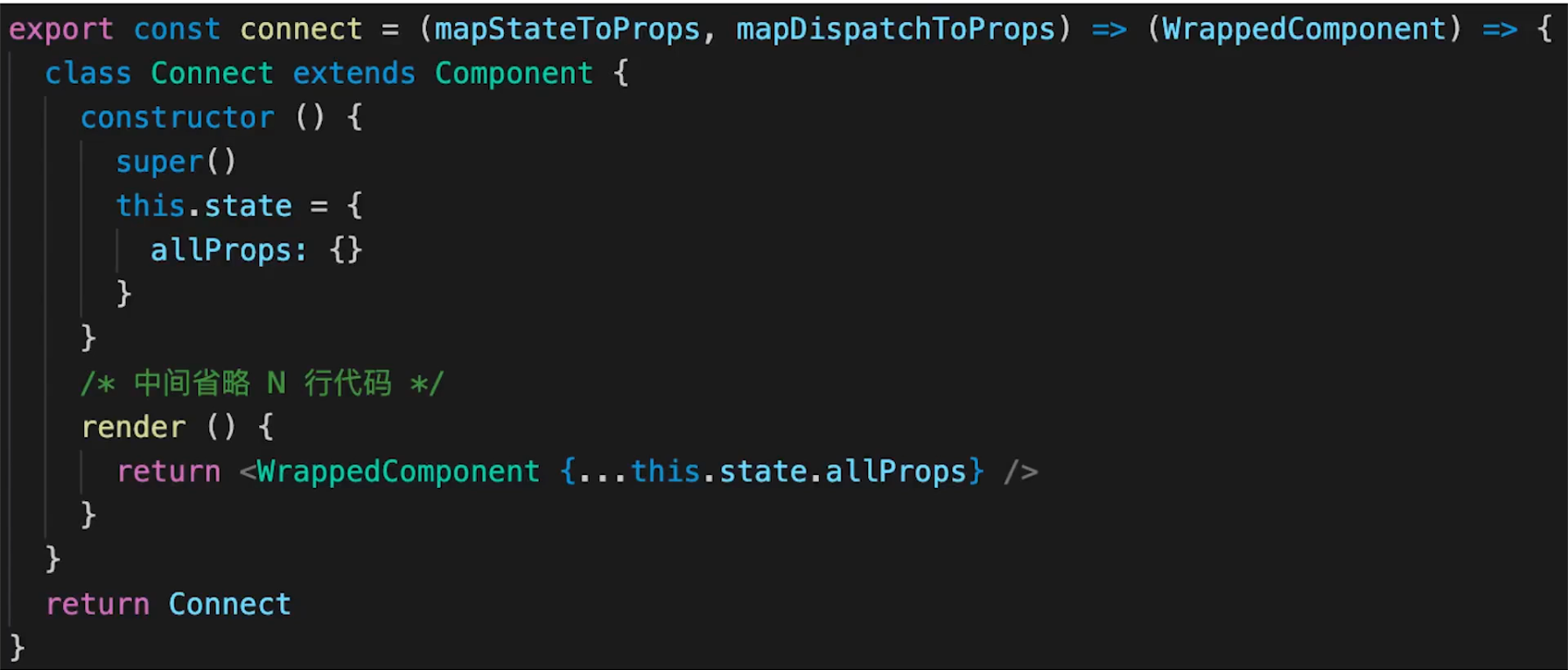
Render Props
Render Props 的核心思想 通过一个函数将 class 组件的 state 作为 props 传递给纯函数组件
react
class Factory extends React.Component {
  constructor() {
    this.state ={
      /* state 即多个组件的公共逻辑的数据*/
    }
  }
  /* 修改 state */
  render(){
    return <div-{this. props. render(this.state)J</div>
  }
}


const App = () =>(
  <Factory render={
      /* render 是一个函数组件*/
      (props) => <p>{props.a} {props.b} ...</p>
    }>
  </Factory>
)示例
react
import React from 'react'
import PropTypes from 'prop-types'

class Mouse extends React.Component {
    constructor(props) {
        super(props)
        this.state = { x: 0, y: 0 }
    }

    handleMouseMove = (event) => {
      this.setState({
        x: event.clientX,
        y: event.clientY
      })
    }

    render() {
      return (
        <div style={{ height: '500px' }} onMouseMove={this.handleMouseMove}>
            {/* 将当前 state 作为 props ,传递给 render (render 是一个函数组件) */}
            {this.props.render(this.state)}
        </div>
      )
    }
}
Mouse.propTypes = {
    render: PropTypes.func.isRequired // 必须接收一个 render 属性,而且是函数
}

const App = (props) => (
    <div style={{ height: '500px' }}>
        <p>{props.a}</p>
        <Mouse render={
            /* render 是一个函数组件 */
            ({ x, y }) => <h1>The mouse position is ({x}, {y})</h1>
        }/>

    </div>
)

/**
 * 即,定义了 Mouse 组件,只有获取 x y 的能力。
 * 至于 Mouse 组件如何渲染,App 说了算,通过 render prop 的方式告诉 Mouse 。
 */

export default AppHOC VS Render Props
- HOC:模式简单,但会增加组件层级
- Render Props:代码简洁,学习成本较高